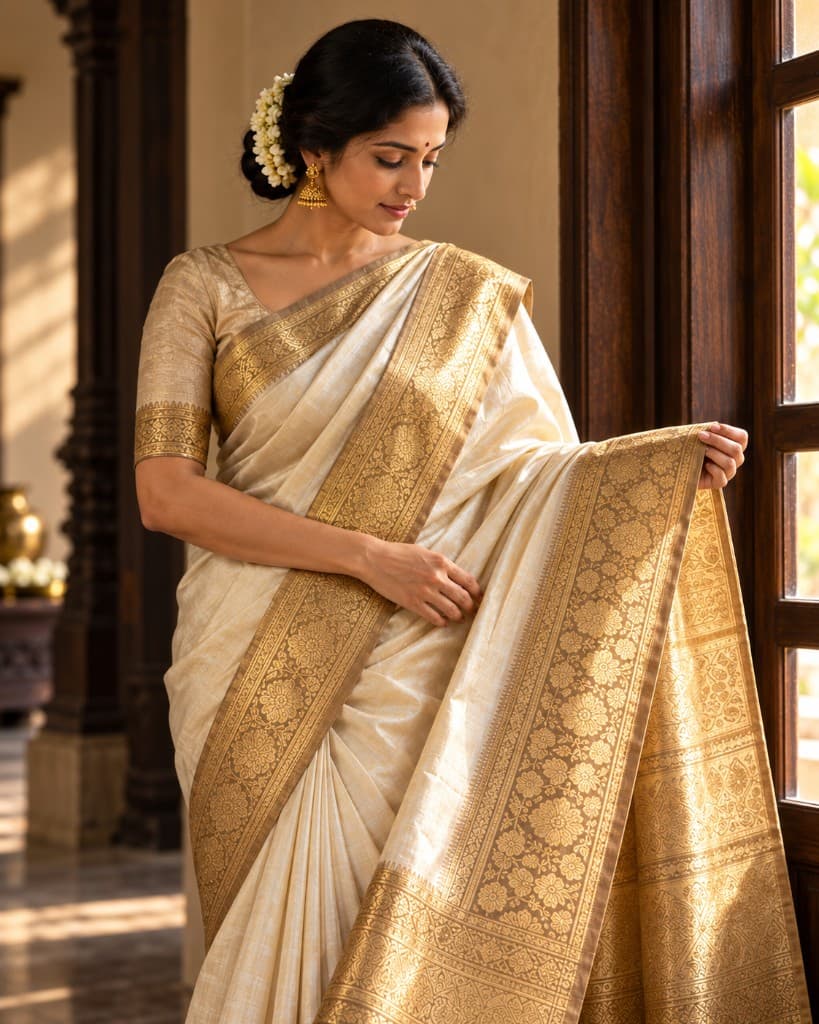
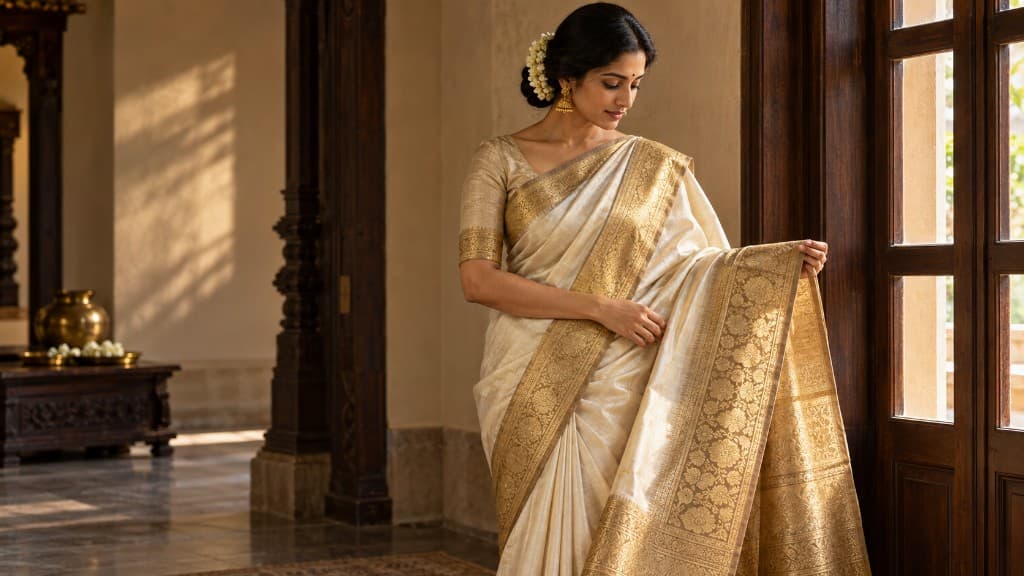
A Kanjivaram can look convincing long before it is pure. The town is Kanchipuram, also called Kanjipuram, and the saree that carries its name is an heirloom only when the silk, the join and the zari agree with one another.
In 2026 the copies are better lit, better finished and easier to find. The test is quieter than the shop floor. It asks where the silk was marked, how the border was joined, and whether the zari is metal or a metallic idea of metal.
Start With the Silk Mark
The Silk Mark is a certification from the Silk Mark Organisation of India. A genuine tag is holographed and traceable to the authorised user who sold the saree. It confirms silk. It does not, by itself, confirm that every thread is mulberry silk from Kanchipuram, or that the zari is pure.
Ask for the tag and the bill in the same name. A missing mark is not automatic proof of a fake, but a mark that cannot be checked is not a mark worth trusting.
Read the Korvai Join
Traditional Kanjivaram borders are woven separately and interlocked with the body in a korvai join. Turn the saree and look along the edge where body meets border. A true join has a row of tiny interlocks, often with a slight difference in the way the threads turn. A printed border, or a border stitched on after the body was finished, will not have that woven handshake.
The pallu should continue the same discipline: motifs that are woven through, not sitting on the surface like a transfer.
Pure Zari Is Not Tested Zari
Pure zari uses silver wire, gold-coated for the gold shades. Tested zari replaces that core with copper and a thin plate of silver or gold. Imitation zari goes further, into metallic yarn that can look bright in the shop and dull, or green, after wear and moisture.
Weight is a clue, not a verdict. A heavily worked pure-zari saree feels dense, and the metal thread should not flake when a discreet inner thread is bent. Ask the house to name the zari type on the bill. “Silk saree” and “pure Kanjivaram” are not the same sentence.
“The price follows the metal, the silk and the time in the weave. It does not follow the brightness of the shop light.”
What a Real One Costs in 2026
There is no single fair price, and any number offered without silk weight, zari type and motif density is theatre. A half-fine or tested-zari saree can be beautiful and still be a different object from a pure-zari Kanjivaram with a temple border and a fully worked pallu.
In 2026, treat a very low price for “pure zari” as a question, not a bargain. Cost climbs with the grams of metal thread, the quality of the mulberry silk, the number of colours and the hours in a contrast border. An heirloom is the piece whose bill can explain those three things.
The Quiet Checklist
Is there a verifiable Silk Mark, and a bill that names the zari?
Does the border meet the body in a woven korvai join?
Is the zari pure, tested, or imitation—and is that written down?
Does the pallu continue the weave, rather than a surface print?
Can the seller explain the price through silk, metal and labour?
A pure Kanjivaram does not need to announce itself. It needs to survive being turned over, read closely and kept.
Editorial Note
This is a VÉYA buying guide, not a laboratory certificate. Silk Mark confirms silk; purity of zari and place of weaving should still be stated by the seller and, where it matters, checked with a qualified textile house.